Loading research data...
Visual Insights
From ACLED Data 2022/03/01 - 2025/03/31
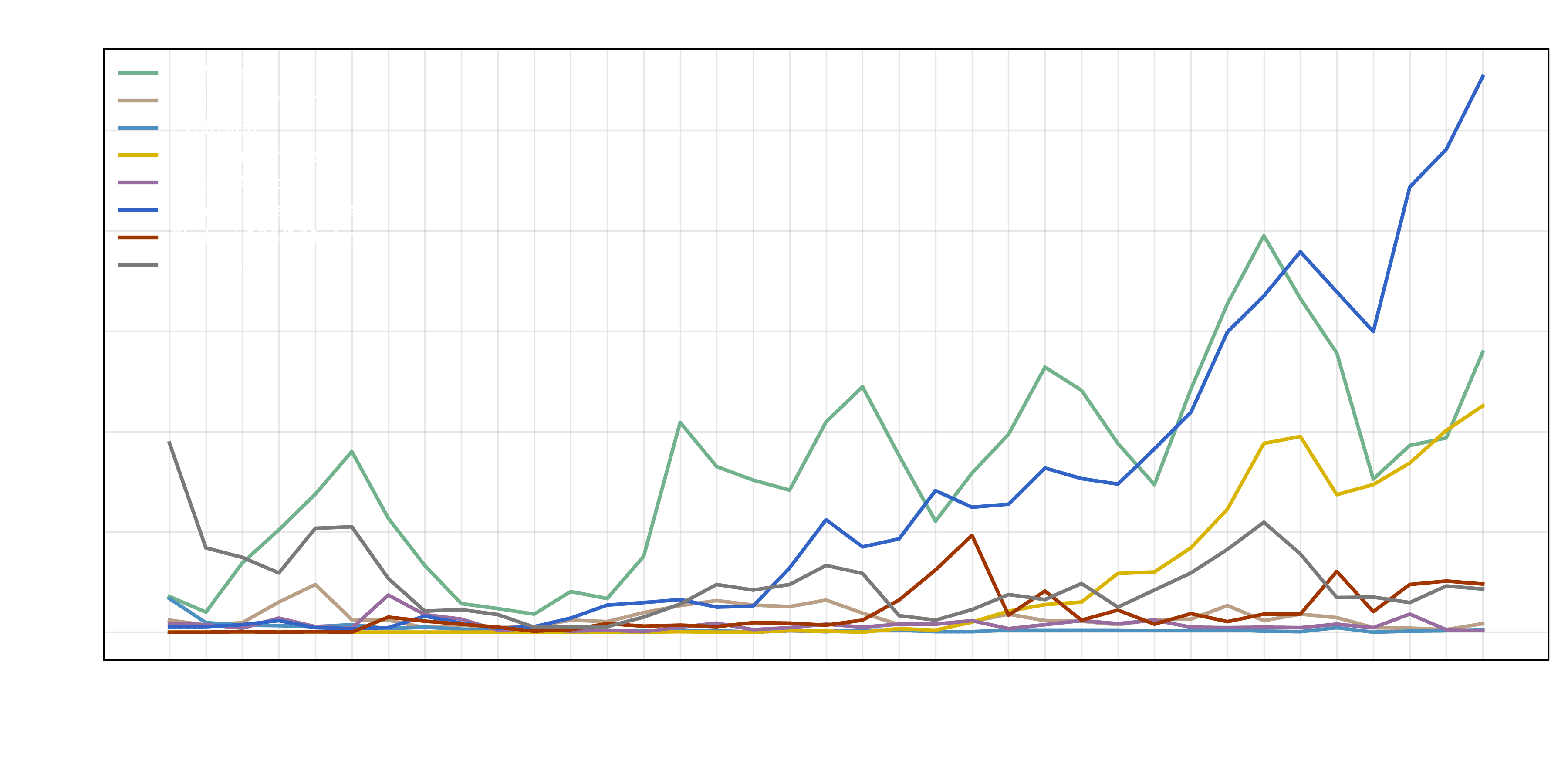
Monthly Trends in Attack Modalities in Ukraine (March 2022 – March 2025)
This time-series line graph illustrates the monthly frequency of distinct attack modalities in Ukraine from March 2022 to March 2025, using ACLED data categorized via event notes to identify air, artillery, missile, and multiple drone classes (Shahed, FPV, other).
Analysis
The visualization highlights a tactical evolution: traditional air operations remain volatile and dominant, yet the most dramatic change is the exponential rise of drone warfare, especially “Other Drone Attacks” and FPV strikes, beginning in late 2023.
Dominance and Volatility of Air Attacks
"Air Attacks" (green line) persist as the highest-volume modality but with pronounced volatility, cresting above 800 monthly incidents in mid-2024. "Artillery / Shelling" (beige line) resurges from late 2023, rising into the top three attack types by early 2025.
Exponential Growth in Drone Warfare
"Other Drone Attacks" (blue line) commence a near-exponential ascent after late 2023, overtaking all other categories by March 2025 at 800+ incidents. Simultaneously, FPV drone strikes (yellow line), negligible through mid-2023, surge to roughly 500 incidents by early 2025.
Stable Low-Frequency Attack Vectors
Shahed-136/131 drones (dark red), missile attacks (purple), and explosions (light blue) remain comparatively low-volume, rarely exceeding 50-100 incidents per month, while the "Unknown" category (gray) starts high in early 2022 before settling into a modest baseline.
Conclusion
Overall, the ACLED series shows conventional air power retaining a central role even as the conflict is reshaped by the rapid scaling of drone-centric tactics, with “Other Drone” and FPV operations matching or surpassing air sorties by early 2025.
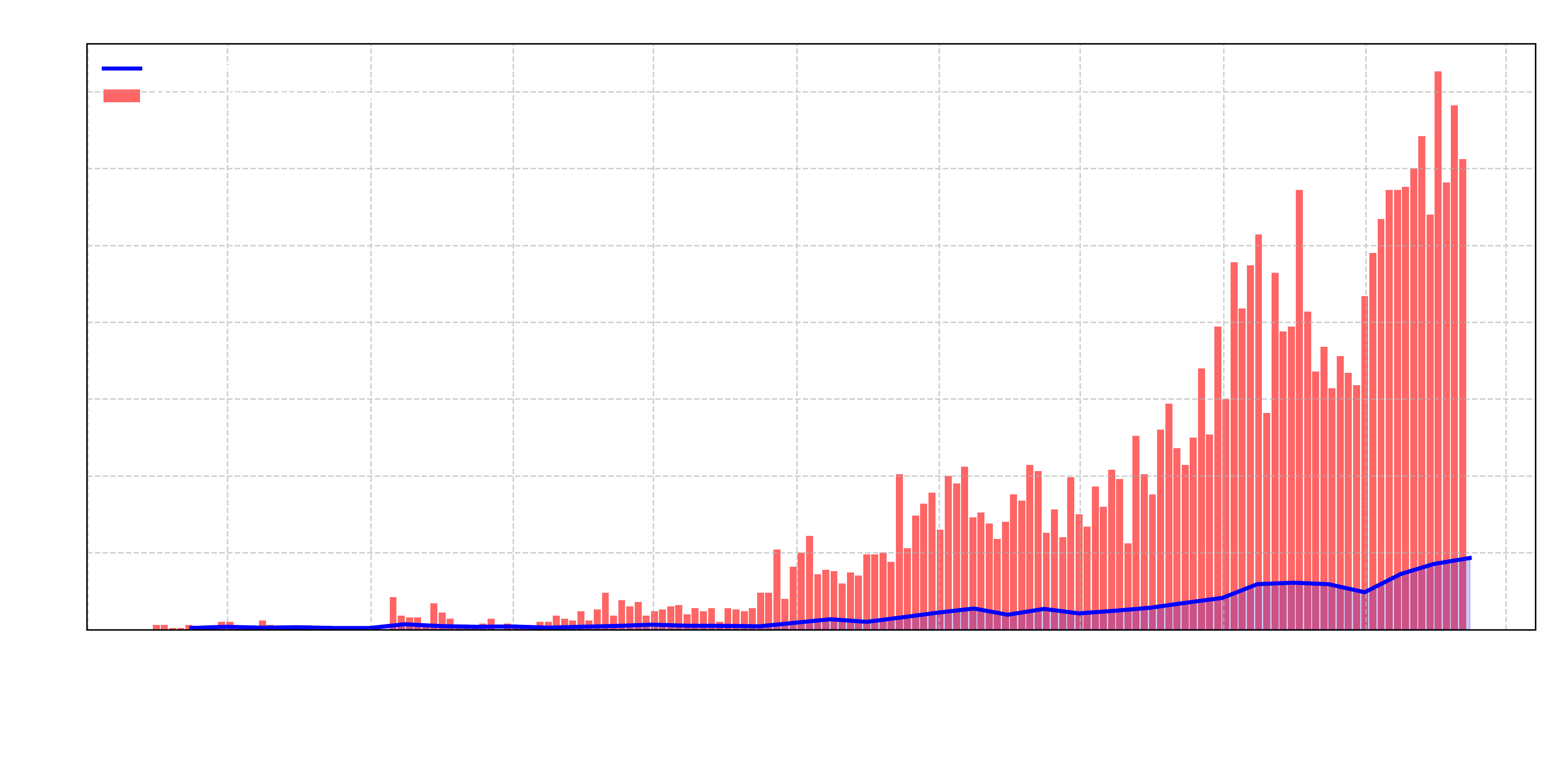
Temporal Analysis of "Shahed" or "Drone" Attack Frequency (ACLED Data)
This composite time-series visual tracks attack records flagged as "Shahed" or "drone" within ACLED. Red bars aggregate weekly attack totals (7-day buckets), while the blue line and shaded area plot the average number of daily attacks per month.
Analysis
The data demonstrates a decisive escalation in drone activity, evolving from sporadic, low-volume occurrences into a sustained, high-intensity pattern that accelerates sharply toward the end of the observation period.
Initial Low-Frequency Phase
Early in the series, weekly totals and monthly averages both hover near zero, indicating that drone-enabled attacks were nascent or rarely deployed during the initial phase.
Emergence and Volatile Growth
The middle of the timeline shows pronounced weekly spikes paired with a steadily rising monthly average, marking the transition from sporadic usage to a regular, if still volatile, deployment cadence.
Rapid Escalation and Saturation
The final portion exhibits large, frequent weekly surges and a steeply climbing monthly baseline, evidencing a sustained, near-exponential expansion in operational tempo.
Conclusion
Collectively, the metrics confirm that drone and Shahed attacks have transitioned from peripheral incidents to a primary offensive vector, with the underlying daily averages accelerating through the most recent period.
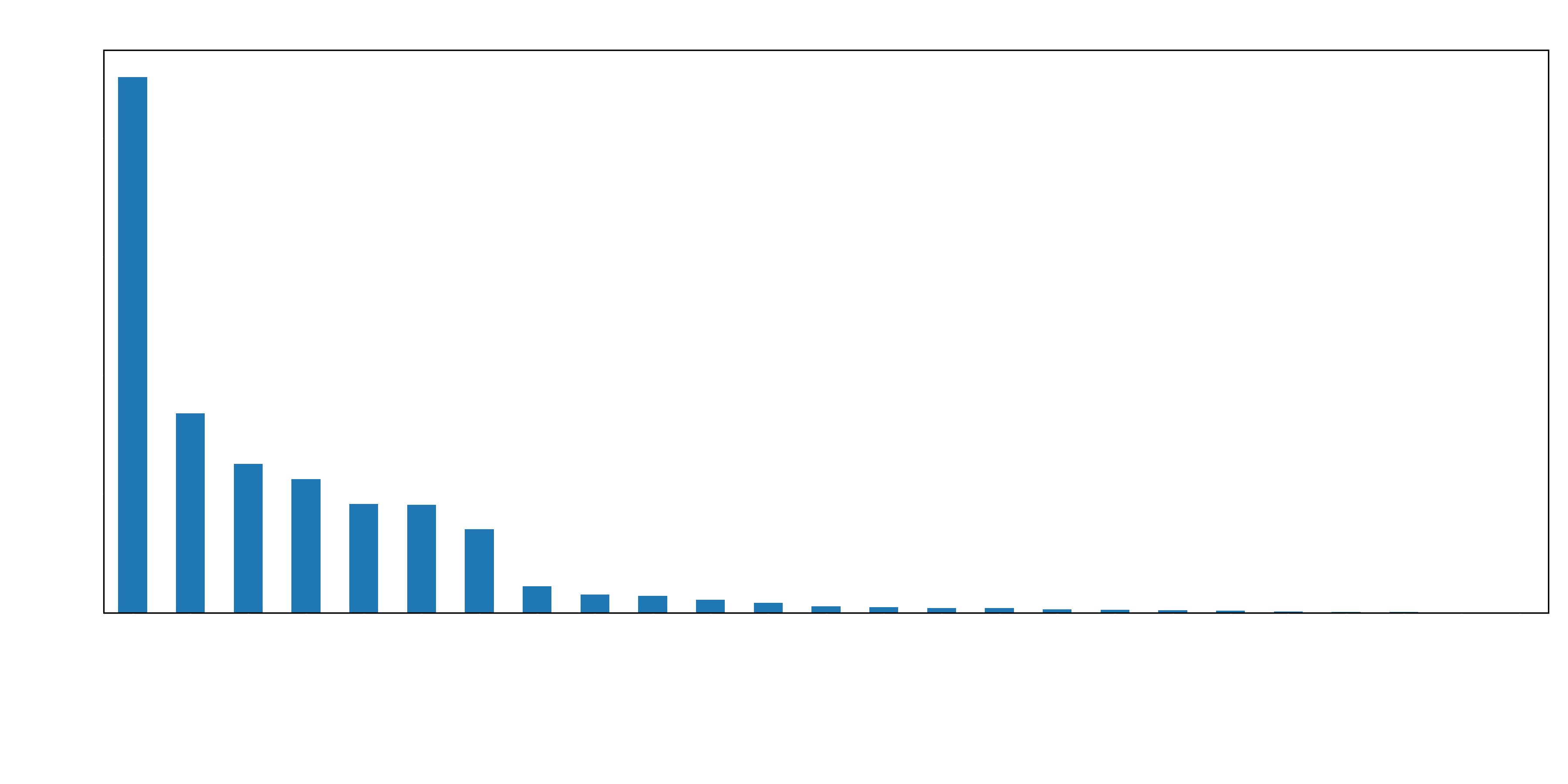
Shahed vs Other Drone Activity
The chart plots the "Number of Attacks" on the Y-axis against discrete administrative "Regions (admin1)" on the X-axis. The distribution exhibits several key features:
Analysis
1. Pronounced Geographical Concentration:
The most salient feature of the data is the extreme concentration of attacks within a few key regions. This pattern strongly deviates from a uniform or normal distribution.
2. Primary Outlier Region
Sumy Oblast** is identified as the principal epicenter of drone attacks, functioning as a significant statistical outlier. It has sustained over 5,000 recorded incidents, a figure that is more than double that of the next most affected region. This suggests a unique strategic or geographical vulnerability specific to this oblast.
3. Secondary Cluster of High-Frequency Attacks:
A secondary group of oblasts experiences a high, albeit substantially lower, volume of attacks. This cluster includes: • Zaporizhia (approx. 2,300 attacks) • Chernihiv (approx. 1,400 attacks) • Kherson (approx. 1,300 attacks) • Dnipropetrovsk (approx. 1,200 attacks) • Donetsk (approx. 1,100 attacks) • Kharkiv (approx. 800 attacks) These regions, primarily located in the north, east, and south of Ukraine, correspond to areas with active frontlines or proximity to the border with the Russian Federation.
Conclusion
The empirical evidence presented in the chart demonstrates that the drone conflict in Ukraine is not a spatially homogenous phenomenon. Instead, it is intensely focused on specific strategic corridors and frontline oblasts. The distribution, with **Sumy Oblast** as a severe outlier and a handful of other regions absorbing the majority of the remaining attacks, highlights a clear geographical prioritization in the targeting strategy of drone warfare. The data strongly suggest that regions bordering the aggressor nation and those containing active lines of military engagement are the primary theaters for this form of aerial assault.